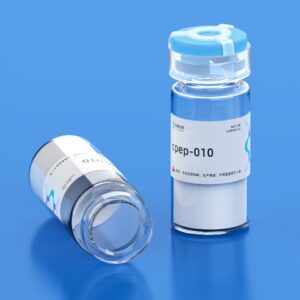
CyLip-10 is a microbial-derived cyclic lipopeptide antimicrobial peptide. CyLip-10 has broad-spectrum antibacterial efficacy, low hemolytic activity, and excellent stability. CyLip-10 disrupts membrane integrity, inhibits biofilm formation, and induces changes in membrane permeability and bacterial cell death. CyLip-10 reduces bacterial load, promotes wound healing, and alleviates inflammatory responses in a mouse skin wound infection model of…
CyLip-20 is a cyclic lipopeptide antimicrobial peptide targeting Gram-positive and Gram-negative bacteria. CyLip-20 has low hemolytic activity and mild in vivo toxicity. CyLip-20 binds bacterial lipopolysaccharide (LPS) to disrupt the integrity of the bacterial outer membrane, inner membrane, and cytoplasmic membrane, causing membrane permeabilization, depolarization, and leakage of cellular contents, and inhibits bacterial biofilm formation….
CyPep-1 is a novel cationic lytic peptide with anti-tumor activity. CyPep-1 exerts strong cytotoxicity by interacting with the negatively charged membranes of cancer cells. CyPep-1 shows strong cytolytic activity against cancer cells both in vitro and in vivo and can be used in research on solid tumors. Product Details Product Name CyPep-1 Biological activity CyPep-1…
Cys-Asp-Pro-Gly-Tyr-Ile-Gly-Ser-Arg-NH2 is a linear peptide from laminin B1 chain that interferes with tumor cell attachment and invasion into basement membrane and has anti-angiogenic effects. Product Information Product Name Cys-Asp-Pro-Gly-Tyr-Ile-Gly-Ser-Arg-NH2 Molecular Weight 966.07 Formula C40H63N13O13S CAS Number 110590-61-9 Sequence Cys-Asp-Pro-Gly-Tyr-Ile-Gly-Ser-Arg-NH2 Sequence Shortening CDPGYIGSR-NH2
Cys-LL37 is a biomaterial with antibacterial properties developed through a method of covalent immobilization onto titanium surfaces. Cys-LL37 uses a flexible hydrophilic polyethylene glycol spacer and selective N-terminal coupling of LL37 to form a surface peptide layer that kills bacteria upon contact. Cys-LL37 can be used in research on the development of novel antibacterial biomaterials….
Cys-Pexiganan TFA is an amphipathic antimicrobial peptide. Cys-Pexiganan TFA has antibacterial activity against Staphylococcus aureus and Pseudomonas aeruginosa, with MICs of 16 ??g/mL and 64.0 ??g/mL, respectively. Cys-Pexiganan TFA can interact with anionic phospholipids of microbial cell membranes and DNA, disrupting cells and causing cell death. Product Details Product Name Cys-Pexiganan TFA Biological activity Cys-Pexiganan…
CysHHC10 is a synthetic antimicrobial peptide showing potent antibacterial properties against both Gram-positive and Gram-negative bacteria. CysHHC10 has MIC values of 10.1 mM, 20.2 mM, 2.5 mM, and 1.3 mM against E. coli, P. aeruginosa, S. aureus, and S. epidermidis, respectively. Product Details Product Name CysHHC10 Biological activity CysHHC10 is a synthetic antimicrobial peptide (AMP),…
CysHHC10 TFA is a synthetic antimicrobial peptide showing potent antibacterial properties against both Gram-positive and Gram-negative bacteria. CysHHC10 TFA has MIC values of 10.1 mM, 20.2 mM, 2.5 mM, and 1.3 mM against E. coli, P. aeruginosa, S. aureus, and S. epidermidis, respectively. Product Details Product Name CysHHC10 TFA Biological activity CysHHC10 TFA is a…
CZEN-002 is an ??-melanocyte-stimulating hormone derivative with anti-inflammatory and antibacterial activities, inhibiting the production of TNF-??. Product Details Product Name CZEN-002 Biological activity CZEN-002 is a derivative of alpha-melanocyte-stimulating hormone that has anti-inflammatory and antibacterial properties, inhibiting the production of TNF-??. Sequence Chain 1:Cys-Lys-Pro-Val Chain 2:Cys-Lys-Pro-Val (Disulfide bridge:Chain 1 Cys1-Chain 2 Cys1) Sequence Shortening Chain…
d-(KLAKLAK)2, Proapoptotic Peptide is a pro-apoptotic peptide whose core mechanism of action is the disruption of organelle membranes, particularly mitochondrial membranes, thereby inducing apoptosis. d-(KLAKLAK)2, Proapoptotic Peptide activates caspase 3/7 activity in cancer cells. Although d-(KLAKLAK)2, Proapoptotic Peptide has very low toxicity to eukaryotic cells extracellularly, it cannot effectively penetrate cell membranes to enter the…
D-Cateslytin is an antimicrobial peptide with potent inhibitory activity against Candida albicans (MIC = 2.9 ??M). D-Cateslytin rapidly enters C. albicans cells, is non-cytotoxic to human gingival fibroblasts, and remains stable in saliva. D-Cateslytin can be used in research on C. albicans-related diseases, such as oral candidiasis. Product Details Product Name D-Cateslytin Biological activity D-Cateslytin…
Product Name Urotensin II, mouse acetate Biological activity Urotensin II, mouse acetate is an endogenous ligand for the orphan G-protein-coupled receptor GPR14 or SENR. Urotensin II, mouse acetate is a potent vasoconstrictor. Urotensin II, mouse acetate plays a physiological role in the central nervous system. Molecular Weight 1692.89 Formula Formula C78H103N18O21S2 Appearance Solid Color White…
Contains information related to marketing campaigns of the user. These are shared with Google AdWords / Google Ads when the Google Ads and Google Analytics accounts are linked together.
90 days
__utma
ID used to identify users and sessions
2 years after last activity
__utmt
Used to monitor number of Google Analytics server requests
10 minutes
__utmb
Used to distinguish new sessions and visits. This cookie is set when the GA.js javascript library is loaded and there is no existing __utmb cookie. The cookie is updated every time data is sent to the Google Analytics server.
30 minutes after last activity
__utmc
Used only with old Urchin versions of Google Analytics and not with GA.js. Was used to distinguish between new sessions and visits at the end of a session.
End of session (browser)
__utmz
Contains information about the traffic source or campaign that directed user to the website. The cookie is set when the GA.js javascript is loaded and updated when data is sent to the Google Anaytics server
6 months after last activity
__utmv
Contains custom information set by the web developer via the _setCustomVar method in Google Analytics. This cookie is updated every time new data is sent to the Google Analytics server.
2 years after last activity
__utmx
Used to determine whether a user is included in an A / B or Multivariate test.
18 months
_ga
ID used to identify users
2 years
_gali
Used by Google Analytics to determine which links on a page are being clicked
30 seconds
_ga_
ID used to identify users
2 years
_gid
ID used to identify users for 24 hours after last activity
24 hours
_gat
Used to monitor number of Google Analytics server requests when using Google Tag Manager