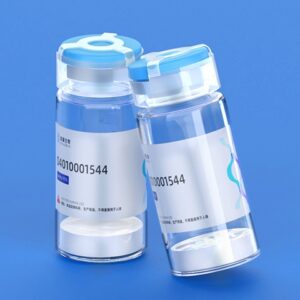
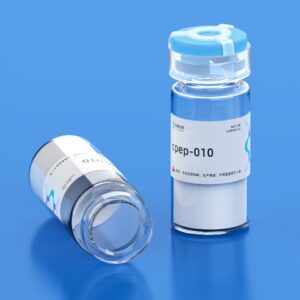
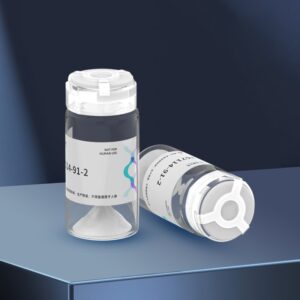
Teverelix (EP 24332) is a GnRH antagonist. Teverelix binds competitively and reversibly to GnRH receptors, thereby suppressing the release of LH and FSH. Teverelix can be used in the research of prostatic hyperplasia, endometriosis, and prostate cancer. Product Information Product Name Teverelix Molecular Weight 1459.13 Formula C74H100ClN15O14 CAS Number 151272-78-5
Thanatin is an inducible cationic antimicrobial peptide. Thanatin is a pathogen-induced ??-hairpin AMP containing a single disulfide bond. Thanatin exhibits broad-spectrum activity against Gram-negative and Gram-positive bacteria as well as various fungi, with MIC values of 0.3-40 ??M, 0.6-40 ??M, and 0.6-20 ??M, respectively. Thanatin has the property of competitively displacing divalent cations on the…
Thanatin TFA is an inducible cationic antimicrobial peptide. Thanatin TFA is a pathogen-induced ??-hairpin AMP containing a single disulfide bond. Thanatin TFA exhibits broad-spectrum activity against Gram-negative and Gram-positive bacteria as well as various fungi, with MIC values of 0.3-40 ??M, 0.6-40 ??M, and 0.6-20 ??M, respectively. Thanatin TFA has the property of competitively displacing…
The K4 peptide is an antimicrobial peptide with strong activity against Gram-positive and Gram-negative bacteria, including human pathogens such as Staphylococcus aureus and marine Vibrio species. Product Details Product Name The K4 peptide Biological activity The K4 peptide is an antimicrobial peptide with strong activity against Gram-positive and Gram-negative bacteria, including human pathogenic bacteria, such…
Thiazoplanomicin (Compound 1) is a thiazole peptide antibiotic. Thiazoplanomicin can be isolated from the deciduous actinomycete Actinoplanes sp. MM794L-181F6. Thiazoplanomicin has potent antibacterial activity against Neisseria gonorrhoeae strains (especially drug-resistant strains) and Gram-positive bacteria, with MIC values of 31.2-125 and 0.5-15.6 ng/mL, respectively. Thiazoplanomicin has no antibacterial activity against E. coli. Thiazoplanomicin can be used…
Thiocoraline is a depsipeptide that can be isolated from the marine actinomycete Micromonospora. Thiocoraline has anti-tumor activity, with IC50 values of 0.002, 0.002, 0.01, and 0.002 ??g/mL in P388, A549, HT-29, and MEL-28 cells, respectively. Thiocoraline also has strong antibacterial activity against Gram-positive microorganisms. Product Details Product Name Thiocoraline Biological activity Thiocoraline is a depsipeptide…
Thiostrepton is an antibiotic that selectively inhibits FOXM1. FOXM1 binds to the YAP/TEAD complex. The binding of the YAP/TEAD/FOXM1 complex to gene regulatory regions that control the cell cycle may affect cell proliferation. Product Details Product Name Thiostrepton Biological activity Thiostrepton is a thiazole antibiotic which selectively inhibits FOXM1. FOXM1 binds to YAP/TEAD complex. YAP/TEAD/FOXM1…
Thiostrepton is a thiazole antibiotic which selectively inhibits FOXM1. FOXM1 binds to YAP/TEAD complex. YAP/TEAD/FOXM1 complex binding at regulatory regions of genes governing cell cycle may impact cell proliferation. Product Information Product Name Thiostrepton Molecular Weight 1664.89 Formula C72H85N19O18S5 CAS Number 1393-48-2 Appearance Solid Color White to off-white Storage Sealed storage, away from moisture Powder…
Product Name ACTH (3-24) (human, bovine, mouse, ovine, porcine, rabbit, rat) Biological activity ACTH (3-24) (human, bovine, mouse, ovine, porcine, rabbit, rat) is the 3-24 fragment of adrenocorticotropic hormone (ACTH). ACTH (3-24) (human, bovine, mouse, ovine, porcine, rabbit, rat) can be used for research of a variety of diseases, including cancer, immune diseases, cardiovascular disease….
Thymalfasin is an immunomodulating agent able to enhance the Thl immune response. Product Information Product Name Thymalfasin Molecular Weight 3108.28 Formula C129H215N33O55 CAS Number 62304-98-7 Appearance Solid Color White to off-white Sequence Ac-Ser-Asp-Ala-Ala-Val-Asp-Thr-Ser-Ser-Glu-Ile-Thr-Thr-Lys-Asp-Leu-Lys-Glu-Lys-Lys-Glu-Val-Val-Glu-Glu-Ala-Glu-Asn Sequence Shortening Ac-SDAAVDTSSEITTKDLKEKKEVVEEAEN Storage Sealed storage, away from moisture Powder -80??C 2 years -20??C 1 year *In solvent : -80??C, 6 months;…
Thymocartin (Thymopoietin II (32-35)) is the 32-35 fragment of the thymic factor (thymopoietin). Thymocartin has shown potential for immunodeficiency diseases research. Product Information Product Name Thymocartin Molecular Weight 516.59 Formula C21H40N8O7 CAS Number 85466-18-8
Product Name Amylin (8-37), rat Biological activity Amylin (8-37), rat is a truncated analog of native Amylin that selectively inhibits insulin-related glucose uptake and glycogen deposition in muscle tissue. Amylin (8-37), rat is a weak amylin receptor (AMY) antagonist. Molecular Weight 3200.61 Formula Formula C140H227N43O43 CAS Number 138398-61-5 Appearance Solid Color White to off-white Sequence…
Product Name Trh-gly Biological activity Trh-gly (TRH-glycine) is a precursor of thyrotropin (TSH)-releasing hormone (TRH) that can release thyrotropin and prolactin. Molecular Weight 420.42 Formula Formula C18H24N6O6 CAS Number 85344-77-0 Sequence Shortening Sequence Shortening Glp-HPG Storage Please store the product under the recommended conditions in the Certificate of Analysis.
Product Name Thymopoietin i/ii (29-41) (bovine) Biological activity Thymopoietin i/ii (29-41) (bovine) is a peptide corresponding to positions 29-41 of bovine thymopoietin II. Thymopoietin i/ii (29-41) (bovine) is a neuromuscular blocker. Formula Formula C73H115N19O22 CAS Number 56795-64-3 Sequence Shortening Sequence Shortening GEQRKDVYVQLYL Storage Please store the product under the recommended conditions in the Certificate of…
Product Name Leptin (116-130) Biological activity Leptin (116-130) is a bioactive leptin fragment. Leptin (116-130) promotes AMPA receptor trafficking to synapses and facilitate activity-dependent hippocampal synaptic plasticity. Leptin (116-130) prevents hippocampal synaptic disruption and neuronal cell death in models of amyloid toxicity. Leptin (116-130) has the potential for the research of Alzheimer’s disease (AD). CAS…
Product Name Amylin (1-13) (human) Biological activity Amylin (1-13) (human) is a fragment and a residues within amyloid cores of Amylin (human IAPP). Amylin is a glucose-regulating hormone, deposits as amyloid fibrils in condition of type II diabetes (T2D). Amylin (1-13) (human) has no effect on firbl formation, as it cannot form fibrils by itself….
Contains information related to marketing campaigns of the user. These are shared with Google AdWords / Google Ads when the Google Ads and Google Analytics accounts are linked together.
90 days
__utma
ID used to identify users and sessions
2 years after last activity
__utmt
Used to monitor number of Google Analytics server requests
10 minutes
__utmb
Used to distinguish new sessions and visits. This cookie is set when the GA.js javascript library is loaded and there is no existing __utmb cookie. The cookie is updated every time data is sent to the Google Analytics server.
30 minutes after last activity
__utmc
Used only with old Urchin versions of Google Analytics and not with GA.js. Was used to distinguish between new sessions and visits at the end of a session.
End of session (browser)
__utmz
Contains information about the traffic source or campaign that directed user to the website. The cookie is set when the GA.js javascript is loaded and updated when data is sent to the Google Anaytics server
6 months after last activity
__utmv
Contains custom information set by the web developer via the _setCustomVar method in Google Analytics. This cookie is updated every time new data is sent to the Google Analytics server.
2 years after last activity
__utmx
Used to determine whether a user is included in an A / B or Multivariate test.
18 months
_ga
ID used to identify users
2 years
_gali
Used by Google Analytics to determine which links on a page are being clicked
30 seconds
_ga_
ID used to identify users
2 years
_gid
ID used to identify users for 24 hours after last activity
24 hours
_gat
Used to monitor number of Google Analytics server requests when using Google Tag Manager