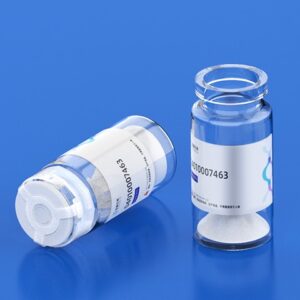
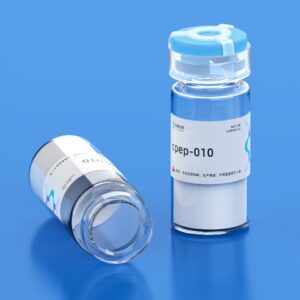
Product Name Oxytocin free acid TFA Biological activity Oxytocin free acid (9-Deamidooxytocin) TFA is an analog of oxytocin in which the glycinamide residue at position 9 in oxytocin has been replaced by a glycine residue. Oxytocin is a pleiotropic, peptide hormone with broad implications for general health, adaptation, development, reproduction, and social behavior. Appearance Solid…
Relamorelin (RM-131), a pentapeptide ghrelin analog, is a selective ghrelin/growth hormone secretagogue receptor (GHSR) agonist with a Ki of 0.42 nM for GHS-1a receptor. Relamorelin is centrally penetrant. Relamorelin increases growth hormone levels and accelerates gastric emptying. Relamorelin has the potential for cachexia, gastroparesis, and gastric/intestinal dysmobility disorders research. Product Information Product Name Relamorelin Molecular…
Relamorelin (RM-131) acetate, a pentapeptide ghrelin analog, is a selective ghrelin/growth hormone secretagogue receptor (GHSR) agonist with a Ki of 0.42 nM for GHS-1a receptor. Relamorelin acetate is centrally penetrant. Relamorelin acetate increases growth hormone levels and accelerates gastric emptying. Relamorelin acetate has the potential for cachexia, gastroparesis, and gastric/intestinal dysmobility disorders research. Product Information…
Relamorelin (RM-131) TFA, a pentapeptide ghrelin analog, is a selective ghrelin/growth hormone secretagogue receptor (GHSR) agonist with a Ki of 0.42 nM for GHS-1a receptor. Relamorelin TFA is centrally penetrant. Relamorelin TFA increases growth hormone levels and accelerates gastric emptying. Relamorelin TFA has the potential for cachexia, gastroparesis, and gastric/intestinal dysmobility disorders research. Product Information…
Reltecimod (AB-103) is a T-cell-specific surface glycoprotein CD28 (TP44) antagonist. Reltecimod has beneficial effects against different bacterial infections, their exotoxins and endotoxins, and ionizing radiation. Reltecimod modulates the inflammatory response by targeting and attenuating the critical CD28/B7-2 co-stimulatory pathway, without inhibiting it. Reltecimod can be used to research necrotizing soft-tissue infections (NSTIs). Product Information Product…
Reltecimod (AB-103) is an antagonist of the T cell-specific surface glycoprotein CD28 (TP44). Reltecimod has good resistance effects against different bacterial infections, bacterial exotoxins and endotoxins, and ionizing radiation. Reltecimod modulates inflammatory responses by targeting and attenuating, but not inhibiting, the critical CD28/B7-2 costimulatory pathway. Reltecimod can be used in research on necrotizing soft tissue…
Reltecimod sodium (AB-103 sodium) is a T-cell-specific surface glycoprotein CD28 (TP44) antagonist. Reltecimod sodium has beneficial effects against different bacterial infections, their exotoxins and endotoxins, and ionizing radiation. Reltecimod sodium modulates the inflammatory response by targeting and attenuating the critical CD28/B7-2 co-stimulatory pathway, without inhibiting it. Reltecimod sodium can be used to research necrotizing soft-tissue…
Reltecimod sodium (AB-103 sodium) is an antagonist of the T cell-specific surface glycoprotein CD28 (TP44). Reltecimod sodium has good resistance effects against different bacterial infections, bacterial exotoxins and endotoxins, and ionizing radiation. Reltecimod sodium modulates inflammatory responses by targeting and attenuating, but not inhibiting, the critical CD28/B7-2 costimulatory pathway. Reltecimod sodium can be used in…
Reltecimod (AB-103) TFA is an antagonist of the T cell-specific surface glycoprotein CD28 (TP44). Reltecimod TFA has good resistance effects against different bacterial infections, bacterial exotoxins and endotoxins, and ionizing radiation. Reltecimod TFA modulates inflammatory responses by targeting and attenuating, but not inhibiting, the critical CD28/B7-2 costimulatory pathway. Reltecimod TFA can be used in research…
Reltecimod (AB-103) TFA is a T-cell-specific surface glycoprotein CD28 (TP44) antagonist. Reltecimod TFA has beneficial effects against different bacterial infections, their exotoxins and endotoxins, and ionizing radiation. Reltecimod TFA modulates the inflammatory response by targeting and attenuating the critical CD28/B7-2 co-stimulatory pathway, without inhibiting it. Reltecimod TFA can be used to research necrotizing soft-tissue infections…
Retatrutide (LY3437943) is a triple agonist peptide of the glucagon receptor (GCGR), glucosedependent insulinotropic polypeptide receptor (GIPR), and glucagon-like peptide-1 receptor (GLP-1R). Retatrutide binds human GCGR, GIPR, and GLP-1R with EC50 values of 5.79, 0.0643 and 0.775 nM, respectively. Retatrutide can be used for the research of obesity. Product Information Product Name Retatrutide Molecular Weight…
Retatrutide (LY3437943) (crude) is the crude form of Retatrutide (HY-P3506). Retatrutide is a triple agonist peptide of the glucagon receptor (GCGR), glucosedependent insulinotropic polypeptide receptor (GIPR), and glucagon-like peptide-1 receptor (GLP-1R). Retatrutide binds human GCGR, GIPR, and GLP-1R with EC50 values of 5.79, 0.0643 and 0.775 nM, respectively. Retatrutide can be used for the research…
Retatrutide (LY3437943) acetate is a triple agonist peptide of the glucagon receptor (GCGR), glucosedependent insulinotropic polypeptide receptor (GIPR), and glucagon-like peptide-1 receptor (GLP-1R). Retatrutide acetate inhibits human GCGR, GIPR, and GLP-1R with EC50 values of 5.79, 0.0643 and 0.775 nM, respectively. Retatrutide acetate can be used for the research of obesity. Product Information Product Name…
Retatrutide (LY3437943) TFA is a triple agonist peptide of the glucagon receptor (GCGR), glucosedependent insulinotropic polypeptide receptor (GIPR), and glucagon-like peptide-1 receptor (GLP-1R). Retatrutide TFA binds human GCGR, GIPR, and GLP-1R with EC50 values of 5.79, 0.0643 and 0.775 nM, respectively. Retatrutide TFA can be used for the research of obesity. Product Information Product Name…
Retro-indolicidin is a biologically active peptide (indolicidin retro-peptide (Rev4) is a 13-amino-acid-residue peptide based on the indolicidin sequence. Indolicidin is a member of the cathelicidin protein family and is a 13-amino-acid-residue cationic antimicrobial peptide amide isolated from the cytoplasmic granules of bovine neutrophils. The synthetic peptide Rev4 has been shown to possess potent in vitro…
Product Name CART(62-76)(human,rat) TFA Biological activity CART(62-76)(human,rat) TFA is a neuropeptide (62-76 residues of the CART peptide) with neurotransmitter-like effects. CART(62-76)(human,rat) TFA can modulate the activity of striatal noradrenergic and corticostriatal and hypothalamic serotoninergic (5-HT) system in the rat brain. Formula Formula C66H100F3N17O25S3 Sequence Sequence Tyr-Gly-Gln-Val-Pro-Met-Cys-Asp-Ala-Gly-Glu-Gln-Cys-Ala-Val Sequence Shortening Sequence Shortening YGQVPMCDAGEQCAV Storage Please store the…
Contains information related to marketing campaigns of the user. These are shared with Google AdWords / Google Ads when the Google Ads and Google Analytics accounts are linked together.
90 days
__utma
ID used to identify users and sessions
2 years after last activity
__utmt
Used to monitor number of Google Analytics server requests
10 minutes
__utmb
Used to distinguish new sessions and visits. This cookie is set when the GA.js javascript library is loaded and there is no existing __utmb cookie. The cookie is updated every time data is sent to the Google Analytics server.
30 minutes after last activity
__utmc
Used only with old Urchin versions of Google Analytics and not with GA.js. Was used to distinguish between new sessions and visits at the end of a session.
End of session (browser)
__utmz
Contains information about the traffic source or campaign that directed user to the website. The cookie is set when the GA.js javascript is loaded and updated when data is sent to the Google Anaytics server
6 months after last activity
__utmv
Contains custom information set by the web developer via the _setCustomVar method in Google Analytics. This cookie is updated every time new data is sent to the Google Analytics server.
2 years after last activity
__utmx
Used to determine whether a user is included in an A / B or Multivariate test.
18 months
_ga
ID used to identify users
2 years
_gali
Used by Google Analytics to determine which links on a page are being clicked
30 seconds
_ga_
ID used to identify users
2 years
_gid
ID used to identify users for 24 hours after last activity
24 hours
_gat
Used to monitor number of Google Analytics server requests when using Google Tag Manager